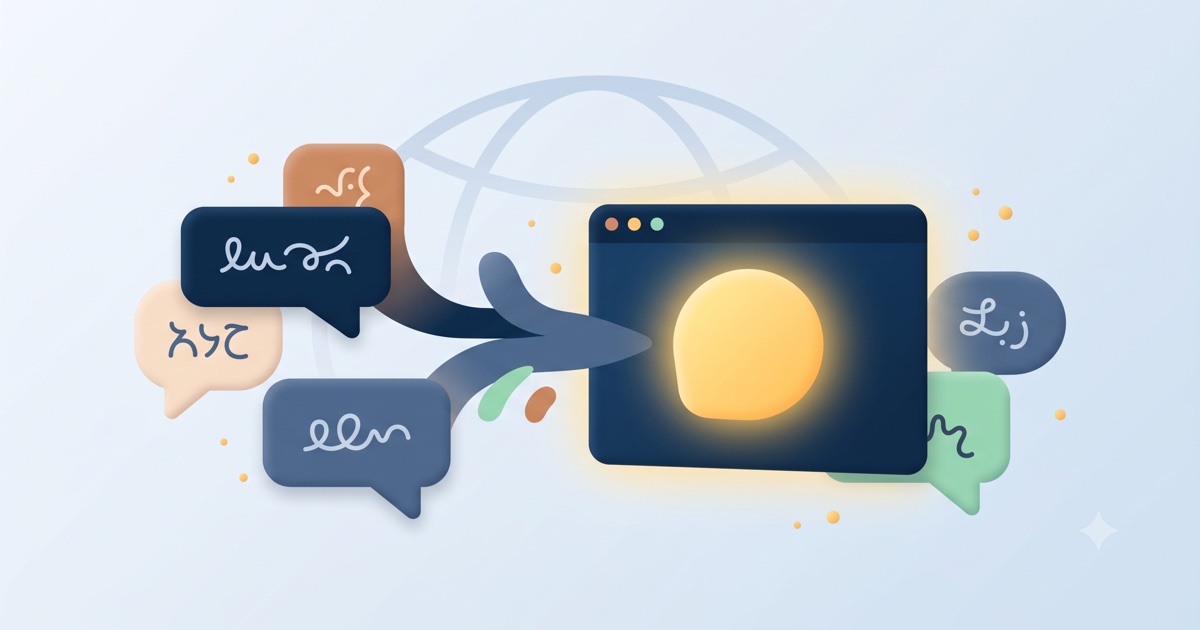
Here is a fact that reshapes how you should think about your website: English is the most common language of online content, yet only around 16% of the world actually speaks it. More than four in five people on the planet do not understand English well. If your website speaks only English, or only your local language, you are, by default, invisible to most of the customers who might want you.
For some businesses that does not matter. A neighbourhood bakery serving one town in one language is fine as it is. But if you serve tourists, a diverse city, an immigrant community, an export market, or simply customers who are more comfortable in their mother tongue, a multilingual website is not a nice-to-have. It is the difference between being understood and being skipped.
People buy in the language they think in
This is not a guess; it is one of the best-documented findings in international commerce. CSA Research, in its landmark “Can’t Read, Won’t Buy” survey of thousands of consumers across dozens of countries, found:
- 76% of online shoppers prefer to buy products with information in their own language.
- 75% prefer to buy and get support in their native language.
- 40% say they will never buy from websites in other languages.
Read that last one again. It is not that customers prefer their language and will grudgingly tolerate yours. Four in ten simply will not buy at all if they cannot read it comfortably. Every one of them is a customer you lose in silence, without ever seeing the enquiry you did not get.
The trust dimension, not just comprehension
Language is about more than understanding the words. A website in someone’s own language signals that you built this for them. It says you understand the market, you respect the customer, and you are not an outsider who expects everyone to adapt to you. That trust converts. In competitive markets, being the business that speaks the customer’s language is often the whole reason they choose you over a rival who does not.
The same logic runs through everything we build. A website that speaks to its exact audience beats a generic one, and language is the most fundamental version of that.
Does a multilingual website help SEO?
Yes, meaningfully, when it is done properly. Every language version of your pages is a new set of pages that can rank for searches in that language. Someone searching in Spanish, Arabic, or Hindi is looking for results in that language, and a site that offers real, well-structured content in it can appear where an English-only competitor never will.
The key is that each language version needs to be genuine content with clean structure, not a machine-translated afterthought hidden from search engines. Done right, multilingual is one of the few moves that expands both your human audience and your search footprint at the same time.
The old reason people avoided it, and why it’s gone
Multilingual websites used to mean one of two painful things: hiring translators for every page and every future change, or bolting on a translate widget that produced clumsy, untrustworthy output and did nothing for search. Both were enough to make most small businesses give up and stay in one language.
That barrier is what modern AI-assisted building removes. With GoClickBuild you can build your website in any major language, or in several languages at once, from the start, without hiring a translator or wrestling with plugins. Change something later and it stays consistent across your languages, updated the same way everything else is: by asking. It fits the same promise as the rest of the platform, any business, in any language, anywhere in the world, live in 30 minutes.
This matters most for businesses reaching mixed or international audiences: a specialty shop shipping gifts or produce, a professional serving a diverse client base, a hospitality business meeting travellers who arrive speaking anything.
Which languages should you add?
You do not need all of them. A small number of well-chosen languages covers the large majority of the world’s internet users, because online activity concentrates in the top handful. Choose by your actual customers:
- Your local majority language, always.
- The languages of the communities you serve, if your area is diverse.
- The language of any market you sell into or ship to.
- English as a common second language, if you have any international reach.
Two or three languages, chosen for who actually walks through your door or lands on your site, will do far more than a dozen chosen at random.
Frequently asked questions
Should my website be in more than one language? If you serve tourists, a diverse community, an immigrant customer base, or any export market, yes. Around 40% of consumers will not buy from a website in a language they do not understand, and 76% prefer to buy in their own language. If you serve one town in one language, one language is fine.
How do I add a language switcher or translate my website? Traditionally you hire translators or add a translation plugin, which is costly or low-quality. With an AI-assisted builder like GoClickBuild you create the site in any major language, or several at once, from the start, with no translator and no plugin, and it stays consistent when you make changes.
Does a multilingual website help SEO? Yes, when each language version is real, well-structured content rather than a hidden machine translation. Each version can rank for searches in that language, reaching customers an English-only site never appears to.
How many languages should a small business website have? Usually two or three, chosen for your actual customers: your local language, the languages of communities you serve, and any market you sell into. A small, well-chosen set covers most of your audience without spreading you thin.
The bottom line
Most of the world does not shop in English, and four in ten people will not buy in a language they cannot read. A multilingual website turns that silent loss into reachable customers, builds trust, and widens your search footprint at once. The translators and plugins that used to make it hard are no longer the barrier. You can build in any language from the start, in about half an hour.